
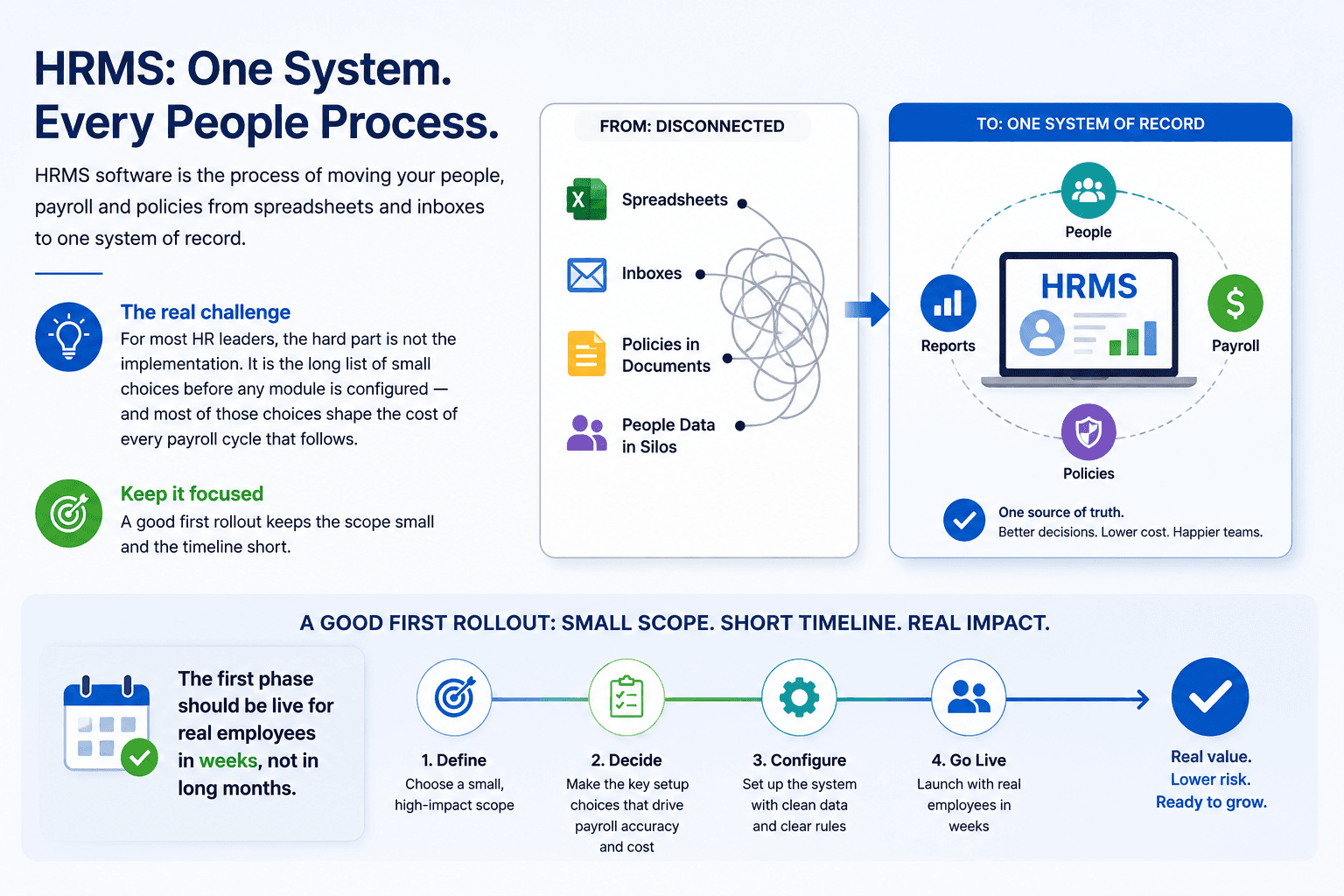
HRMS software is the process of moving your people, payroll and policies from spreadsheets and inboxes to one system of record. For most HR leaders, the hard part is not the implementation. It is the long list of small choices before any module is configured — and most of those choices shape the cost of every payroll cycle that follows.
A good first rollout keeps the scope small and the timeline short. The first phase should be live for real employees in weeks, not in long months.
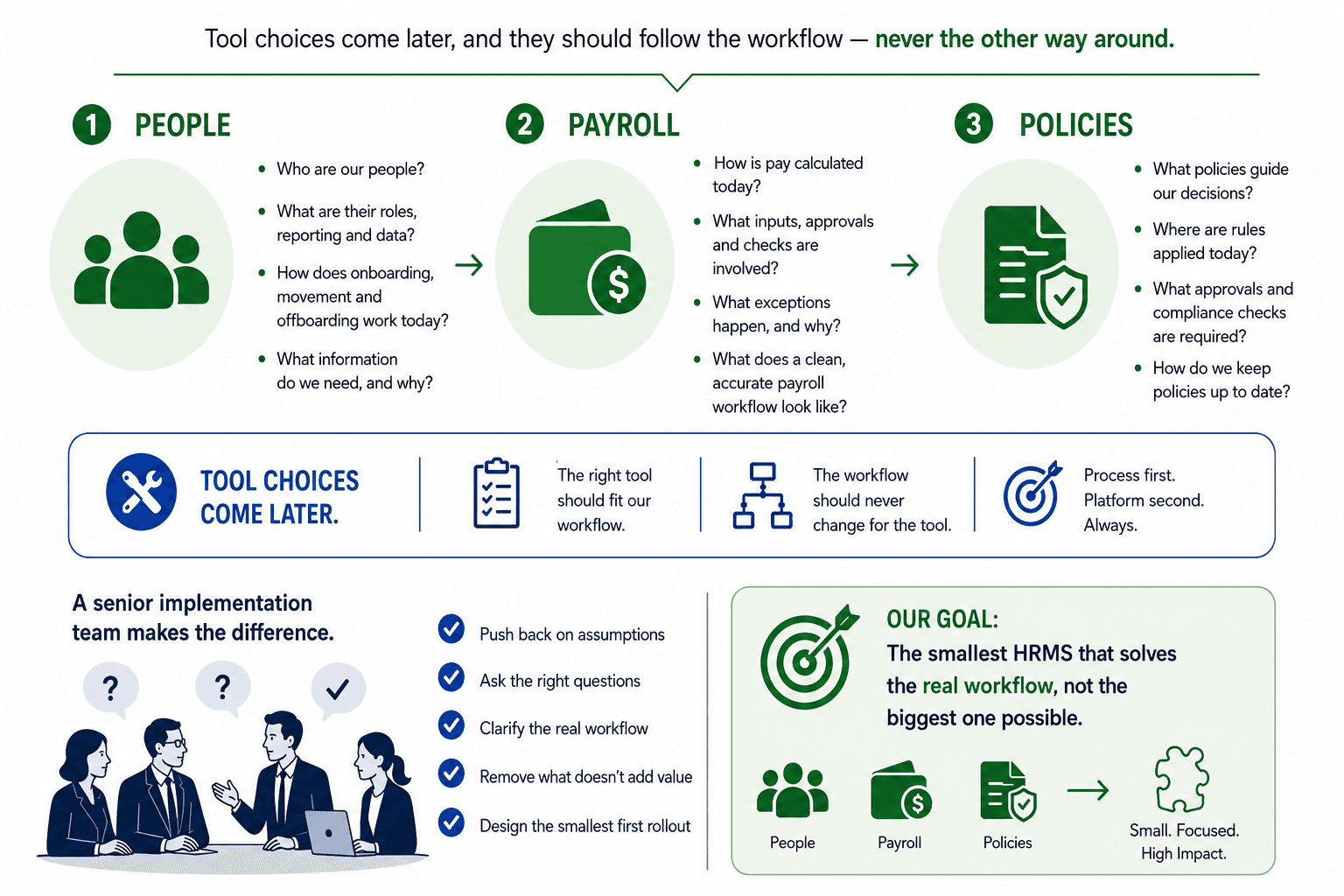
The right HRMS software partner does not start with modules — they start with the right questions, asked in the very first call.
Start with the process, not the platform.
The first call should be about the people, the payroll and the policies. Tool choices come later, and they should follow the workflow — never the other way around.
A senior implementation team will push back, ask the right questions, and shape a small first rollout. The goal is the smallest HRMS that solves the real workflow, not the biggest one possible.
Pick the deployment that fits operations.
If your business is regulated or runs sensitive payroll, on-premises HRMS often makes sense. If you are scaling fast across multiple cities or countries, cloud HRMS leads.
When the operation is hybrid, a modular HRMS that supports both cloud and on-premises can ship one rollout with one team. A senior partner will help you pick cloud-first, on-premises-first, or a hybrid setup in the first scoping call.
What a clean HRMS rollout looks like.
A short discovery call. A clear module list. A small configuration plan. One project board, one team, weekly Friday demos on real employee data. The HR leader always knows exactly where the rollout stands.
No long silences. No "we will show you in four weeks". The first module should run a parallel payroll cycle by the second or third sprint at the latest.
Data migration, compliance setup and the boring-but-critical post-launch work are owned by the team. The HR leader only signs off on the final go-live step after parallel runs match exactly.
What slows most HRMS rollouts down.
Scope creep is the biggest one. Every "small extra module" added mid-rollout pushes go-live back by weeks. A senior partner will gently say no, or move it to a clear post-launch list.
The second is decision lag. If HR cannot review demo configurations on time, the rollout slows down. Weekly demos work only if both sides show up for them.
The third is hiding bad news. A serious team flags data gaps and compliance risks early and openly. Surprises near go-live are almost always the result of silence earlier.
What you should own when it goes live.
You should own the data, the configurations, the admin access, the integrations and every employee record. A serious team hands all of this over without question.
After go-live, the team can stay on a monthly retainer for updates and new modules, or you can run it fully in-house. The choice is always yours alone. Book a demo here.
Need to talk to a human sooner than later? Book a demo through the demo flow, and skim about HRVixa if you want context on the team first.